The Kingdom without Hands
I like the book of Daniel because it presents the end of time in a way that includes hope and redemption. In Daniel chapter 2, we find the story of the wise men of Babylon, who were trained to read the future but failed to do so when King Nebuchadnezzar asked them to recount and interpret the disturbing dream he had had. Perhaps the king was testing the wise men’s abilities to ensure he received a legitimate interpretation.
The news of the wise men’s failure to retell and interpret the dream reached Daniel as the king’s guards came to execute these men. Daniel asked for an audience with the king so that he could recount the dream and explain its meaning.
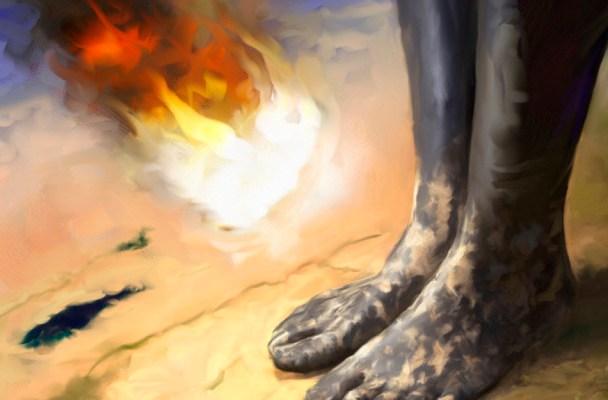
With God’s help, Daniel was successful. He retold the king’s dream and the meaning of its colossal statue with its with parts made from a variety of materials. Daniel explained that Babylon was the gold head, Medo-Persia the silver chest and arms, Greece the bronze belly and thighs, and Rome the iron legs, kingdoms that would fall, leading to a time when the world would be divided into many smaller kingdoms represented by the iron and clay feet.
Daniel explained the dream as a divine message demonstrating the transient nature of human power. Because the colossal statue stood on clay, it was unstable, with failing infrastructure doomed to collapse. Daniel’s interpretation suggests that God wants us to remember our beginnings: clay and dust. “The Lord God formed man of the dust of the ground” (Genesis 2:7). That is how we are constituted. We were made from clay, and we go back to clay. “For dust you are, And to dust you shall return” (Genesis 3:19).
These may be ominous words that we don’t like to think about, but they offer divine insight into our very being: we are ontologically fragile and so is human reality. We can see the downward trend of our world, the decline from gold to silver, bronze, iron, and then nothing more than dust. No one considers dust a valuable commodity.
Daniel then explained to the king the following aspect of his dream: “You watched while a stone was cut out without hands, which struck the image on its feet of iron and clay, and broke them in pieces” (Daniel 2:34). According to Daniel, this stone cut without hands would only arise after the other four kingdoms have fallen into dust The stone kingdom that God sets up comes when human history has reached the time of the divided kingdoms. We are now living in divided and fragile times. The only solution to an unstable infrastructure is the end of this world in anticipation of a kingdom of hope that fills the earth and that has no end (Daniel 2:44-45). Redemption cannot come from the failing nations of our world, unless it is cosmic there is no hope.
I think the most important message for our day is knowing that the stone kingdom is cut without hands (Daniel 2:34, 45). Many Christians seek to bring about God’s kingdom through political force and power, but the stone kingdom must be cut without hands. God does not want us to look through the lens of empire, for He does not initiate the force of Babylon, Medo-Persia, Greece, or Rome to bring about His kingdom. Jesus’s methods contrast with those used by the kingdoms of this world. His is an unexpected kingdom of hope cut without hands—without power. It is not of this creation (Hebrews 9:11, 24). Unless God is bringing a new world, there is no hope or salvation.
Daniel’s predictions about each kingdom represented by a metal in the statue came true with unfailing accuracy, but Daniel chapter 2 tells us that more important than having futuristic predictions is knowing what God’s character is like. After receiving the interpretation of the king’s dream from God, Daniel said something significant: “Blessed be the name of God forever and ever, For wisdom and might are His” (Daniel 2:20).
Daniel understood the most important interpretation of all: God’s name must be blessed. When your life is threatened and you lack answers, when everything seems chaotic, and when everything is falling and collapsing around you, You must bless God’s name. When the nations and kingdoms of this world are crumbling, we must bless God’s name.
God’s name represents His true character. Blessing God’s name means not only recognizing that we are dependent upon Him but also agreeing that His noncoercive love is His defining characteristic and the means by which He saves us and brings about a new world.
Are we blessing God’s name?
 Theological InTents
Leave a comment